
Car Won’t Start: A Step-by-Step Diagnosis Checklist
Car Won’t Start: A Step-by-Step Diagnosis Checklist
Few car problems are more frustrating than turning the key (or pressing the button) and getting nothing—or something that doesn’t sound right.
The good news is that most no-start problems fall into a small number of categories. With a systematic approach, you can often narrow the issue quickly before replacing parts or calling for a tow.
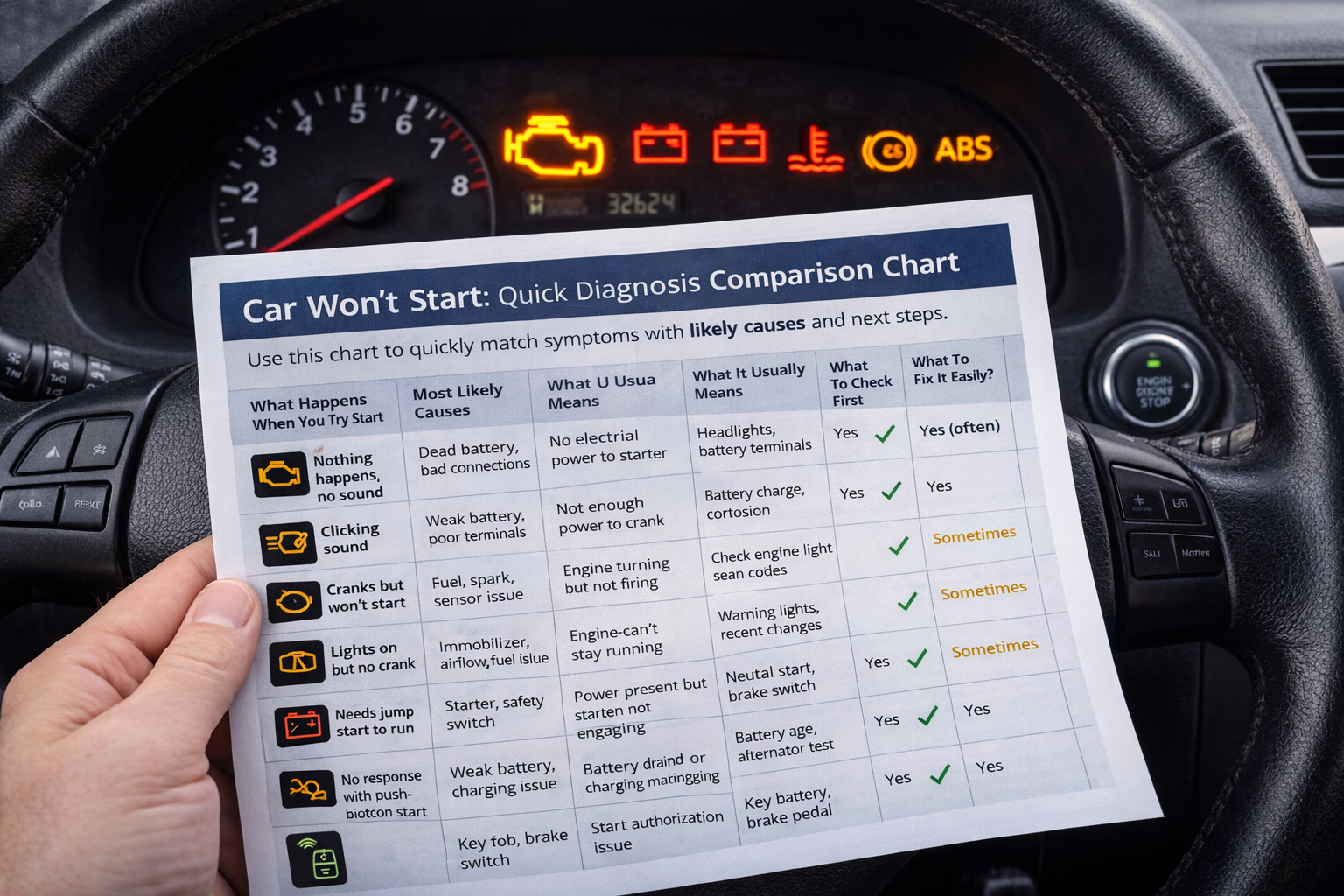
Car Won’t Start: Quick Diagnosis Comparison Chart
Use this chart to quickly match symptoms with likely causes and next steps.
| What Happens When You Try to Start | Most Likely Causes | What It Usually Means | What To Check First | Can You Fix It Easily? |
|---|---|---|---|---|
| Nothing happens, no sound | Dead battery, bad connections | No electrical power to starter | Headlights, battery terminals | Yes (often) |
| Clicking sound | Weak battery, poor terminals | Not enough power to crank | Battery charge, corrosion | Yes |
| Cranks but won’t start | Fuel, spark, sensor issue | Engine turning but not firing | Check engine light, scan codes | Sometimes |
| Starts then stalls | Immobilizer, airflow, fuel issue | Engine can’t stay running | Warning lights, recent changes | Sometimes |
| Lights on but no crank | Starter, safety switch | Power present but starter not engaging | Neutral start, brake switch | Sometimes |
| Needs jump start to run | Weak battery, charging issue | Battery drained or not charging | Battery age, alternator test | Yes |
| No response with push-button start | Key fob, brake switch | Start authorization issue | Key battery, brake pedal | Yes |
This checklist walks through what to check first, what symptoms mean, and when to stop troubleshooting.
Step 1: What Happens When You Try to Start the Car?
The sound—or lack of sound—tells you a lot.
Pay close attention to what you hear and see.
Common scenarios:
- Nothing happens at all
- Clicking sound
- Engine cranks but won’t start
- Engine starts then stalls
- Dashboard lights but no crank
Each points to a different system.
Step 2: No Crank, No Sound
If nothing happens when you try to start the car:
Likely causes:
- Dead battery
- Loose or corroded battery terminals
- Faulty ignition switch
- Starter relay or fuse issue
What to check first:
- Do the headlights turn on?
- Are interior lights dim or off?
- Are battery terminals clean and tight?
A completely silent no-start is usually electrical.
Step 3: Clicking Sound When You Turn the Key
A clicking sound almost always points to insufficient power.
Common causes:
- Weak or dying battery
- Poor battery connections
- Failing starter
What to check:
- Battery age
- Terminal corrosion
- Try a jump start
If the car starts with a jump, the battery or charging system is likely the issue.
Step 4: Engine Cranks but Won’t Start
If the engine turns over but doesn’t fire, the problem is usually fuel, spark, or air.
Common causes:
- Fuel delivery issue
- Ignition system failure
- Sensor preventing startup
- Security or immobilizer issue
What to observe:
- Does the engine sound normal while cranking?
- Does it try to start briefly?
- Does the check engine light behave normally?
Cranking but not starting often requires diagnostics rather than guessing.
Step 5: Starts Then Immediately Stalls
This often indicates a system preventing the engine from staying running.
Possible causes:
- Immobilizer or anti-theft system
- Faulty mass airflow sensor
- Vacuum leaks
- Fuel pressure problems
What to check:
- Dashboard warning lights
- Key or fob issues
- Recent repairs or battery disconnects
Modern vehicles may disable operation if a fault is detected.
Step 6: Dashboard Lights On but No Start
If lights and accessories work but the engine won’t start:
Likely causes:
- Starter motor failure
- Neutral safety switch issue
- Brake or clutch switch problem
- Push-button start system fault
Try:
- Shifting to neutral and starting
- Pressing the brake firmly
- Checking for warning messages
These issues are common and often overlooked.
Step 7: Check for Warning Lights or Messages
Always look at the dashboard before continuing.
Important indicators:
- Check engine light behavior
- Security or key warning lights
- Battery or charging warnings
Warning lights provide clues even when the engine won’t start.
Step 8: When a Diagnostic Scan Helps
A scan is useful if:
- The engine cranks but won’t start
- Warning lights are present
- The problem occurred suddenly
- The car stalled unexpectedly
Diagnostic codes can:
- Identify sensor failures
- Reveal immobilizer or communication issues
- Prevent unnecessary part replacement
Even a basic scan is better than guessing.
Step 9: When to Stop Troubleshooting
You should stop diagnosing and seek professional help if:
- Electrical testing becomes complex
- Fuel system access is required
- The engine intermittently starts and dies
- You’re unsure about safety
Good diagnostics include knowing your limits.
The Bottom Line
A car that won’t start doesn’t mean everything is broken.
By identifying:
- What the car does
- What sounds you hear
- What lights appear
You can narrow the issue quickly and avoid replacing the wrong parts.
Most no-start problems come down to power, fuel, spark, or control systems—and each leaves clues if you know where to look.
Frequently Asked Questions
Why won’t my car start but the lights turn on?
This usually points to a starter, battery connection, or safety switch issue. The battery may have enough power for lights but not enough to crank the engine.
Does clicking always mean a bad starter?
Not always. Clicking is more commonly caused by a weak battery or poor battery connections. Starters fail less often than batteries.
Can a bad alternator cause a car not to start?
Yes. If the alternator isn’t charging the battery, the battery can drain and prevent the car from starting—even if it was working previously.
Will a bad fuel pump cause a no-start?
Yes. If the engine cranks but won’t start, fuel delivery problems such as a failed fuel pump or relay are possible causes.
Can the check engine light prevent my car from starting?
In some cases, yes. Certain sensor failures or immobilizer-related faults can prevent the engine from starting to protect the vehicle.
Should I jump-start my car if it won’t start?
Jump-starting is safe if the issue is battery-related. If the car starts with a jump, the battery or charging system likely needs attention.
How do I know when to stop troubleshooting?
Stop if the problem involves fuel system access, complex electrical testing, or if you’re unsure about safety. At that point, professional diagnosis is the safest option.


