
Car Shakes While Driving: A Diagnosis Checklist (What the Vibration Is Telling You)
Car Shakes While Driving: A Diagnosis Checklist (What the Vibration Is Telling You)
Feeling your car shake while driving can be unsettling. Sometimes it’s subtle. Other times it feels severe enough to make you worry something is about to fail.
The key thing to understand is this:
where and when the shaking happens tells you more than the shaking itself.
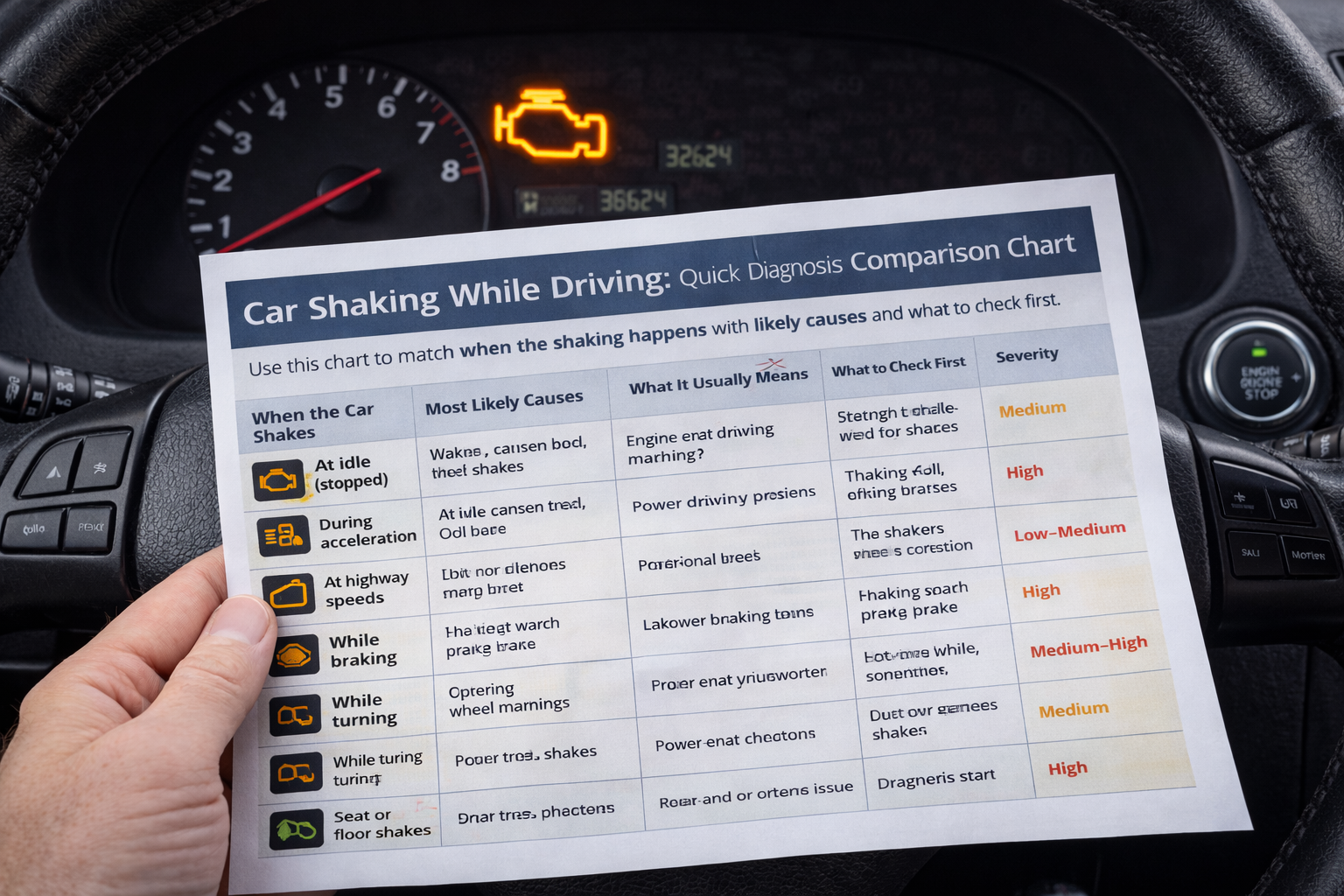
Car Shaking While Driving: Quick Diagnosis Chart
Use this chart to match when the shaking happens with likely causes and what to check first.
| When the Car Shakes | Most Likely Causes | What It Usually Means | What to Check First | Severity |
|---|---|---|---|---|
| At idle (stopped) | Misfire, vacuum leak, bad mounts | Engine not running smoothly | Check engine light, RPM fluctuation | Medium |
| During acceleration | Misfire under load, CV joints | Power delivery problem | Flashing CEL, clicking noises | High |
| At highway speeds | Tire imbalance, bent wheel | Rotational issue | Tire balance, wheel condition | Low–Medium |
| While braking | Warped rotors, brake wear | Uneven braking force | Steering wheel shake, pedal pulse | High |
| While turning | CV joints, wheel bearings | Drivetrain or suspension wear | Clicking while turning | Medium–High |
| Steering wheel shakes | Front tires, brakes | Front-end vibration | Tire wear, brake rotors | Medium |
| Seat or floor shakes | Rear tires, drivetrain | Rear-end or exhaust issue | Rear tire balance, mounts | Medium |
| Shaking + power loss | Misfire, fuel delivery | Engine performance issue | Diagnostic scan | High |
This guide breaks down the most common vibration scenarios, what they usually mean, and what to check first—before replacing parts or approving repairs.
Step 1: When Does the Shaking Happen?
Start by identifying when the vibration occurs. This narrows the cause faster than any tool.
Common scenarios:
- Shaking at idle
- Shaking while accelerating
- Shaking at highway speeds
- Shaking while braking
- Shaking while turning
Each points to a different system.
Step 2: Shaking at Idle
If the car shakes while stopped but smooths out when driving, the issue is usually engine-related.
Common causes:
- Engine misfire
- Vacuum leaks
- Dirty fuel injectors
- Worn engine mounts
What to check first:
- Check engine light behavior
- Rough idle or fluctuating RPM
- Recent maintenance history
Idle vibration is often diagnostic-related rather than suspension-related.
Step 3: Shaking During Acceleration
Vibration that appears when you press the gas often points to drivetrain or engine performance issues.
Common causes:
- Misfiring under load
- Failing ignition coils
- CV joint wear
- Transmission or drivetrain issues
What to check:
- Does it worsen under heavy acceleration?
- Does the check engine light flash?
- Any clicking noises while accelerating?
Acceleration-related shaking should never be ignored.
Step 4: Shaking at Highway Speeds
If the car shakes mostly at higher speeds, wheels and tires are the first place to look.
Common causes:
- Unbalanced tires
- Bent wheels
- Uneven tire wear
- Loose lug nuts
What to check:
- Does the vibration increase with speed?
- Does it feel rhythmic?
- Was recent tire work done?
Highway-speed vibration is often one of the simplest issues to fix.
Step 5: Shaking While Braking
If the shaking happens primarily when braking, it’s often brake-related.
Common causes:
- Warped brake rotors
- Uneven brake pad wear
- Suspension wear revealed under braking
What to check:
- Does the steering wheel shake while braking?
- Does the brake pedal pulse?
- Does braking feel inconsistent?
Brake-related shaking is a safety concern and should be addressed promptly.
Step 6: Shaking While Turning
Vibration or shuddering during turns often points to suspension or drivetrain components.
Common causes:
- Worn CV joints
- Failing wheel bearings
- Suspension component wear
- Power steering issues
What to check:
- Clicking sounds while turning
- Vibration only on left or right turns
- Power steering warning lights
Turning-related shaking often worsens over time if ignored.
Step 7: Steering Wheel vs Seat Vibration
Where you feel the shake matters.
Steering wheel vibration often indicates:
- Front tire or wheel issues
- Brake or suspension problems
Seat or floor vibration often indicates:
- Rear tire imbalance
- Drivetrain or exhaust issues
This distinction helps narrow diagnosis quickly.
Step 8: When a Diagnostic Scan Helps
A scan is helpful if:
- Shaking is accompanied by a check engine light
- The vibration appears suddenly
- Performance is reduced
- The issue occurs under load
Codes related to misfires, sensors, or fuel delivery can guide the next step.
Step 9: When to Stop Driving
You should stop driving and seek help if:
- The check engine light flashes
- The shaking is severe or worsening
- Power loss occurs
- Unusual noises accompany the vibration
Ignoring severe vibration can cause secondary damage.
The Bottom Line
A car that shakes is communicating a problem—not failing randomly.
By identifying:
- When the shaking occurs
- Where you feel it
- What other symptoms appear
You can narrow the cause quickly and avoid unnecessary repairs.
Most vibration issues fall into engine, wheels/tires, brakes, or suspension—and each leaves clear clues if you know how to listen.
Frequently Asked Questions
Is it safe to drive if my car is shaking?
It depends on the severity and when the shaking occurs. Mild vibration at highway speeds may be safe short term, but shaking during braking, acceleration, or with power loss should be addressed immediately.
Can bad tires cause a car to shake?
Yes. Unbalanced, unevenly worn, or damaged tires are one of the most common causes of vibration, especially at higher speeds.
Why does my car shake only when I accelerate?
Shaking during acceleration often points to engine misfires, ignition problems, or drivetrain components like CV joints reacting under load.
Does shaking always mean something expensive is broken?
No. Many vibration issues are caused by simple problems such as tire imbalance, worn mounts, or minor brake issues. Diagnosis helps avoid unnecessary repairs.
Can a misfire cause shaking without a flashing check engine light?
Yes. Some misfires are mild enough not to trigger a flashing light but can still cause noticeable vibration, especially at idle or under load.
Why does the steering wheel shake but not the whole car?
Steering wheel vibration usually indicates a front-end issue, such as front tire imbalance, brake rotor problems, or suspension wear.
Should I get an alignment if my car shakes?
Alignment issues usually cause pulling or uneven tire wear rather than shaking, but misalignment combined with other issues can contribute to vibration.


